Report Comment Bank: 150+ Free Report Comments for Australian Teachers (2026)
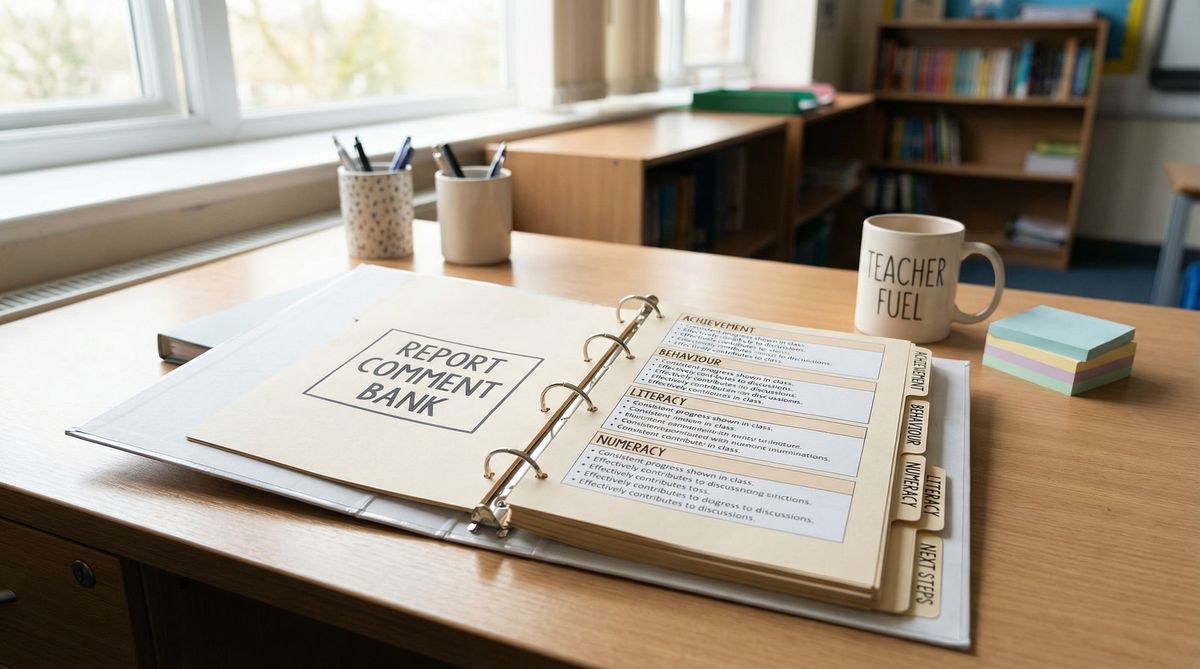
It's report season again. Twenty-five students means 25 report comments, and each one has to cover several subjects and still sound like it was written about that student.
This report comment bank gives you a head start. It has more than 150 report comments for Australian primary teachers, sorted by subject, by year band (Years 1 and 2, 3 and 4, 5 and 6) and by level: High, Medium and Low. Each subject comment is adapted from ReportRocket's criteria, which are written from the Australian Curriculum V9.0 for every year level. The curriculum code behind each comment is listed under its year band, so you can check it on the Australian Curriculum website.
Use them as building blocks. A student's comment usually draws on a few subjects, so pick a sentence from each subject you're reporting on and join them up. For effort, behaviour and social skills, see our general report comments for primary school. To see a full comment across several subjects, see our Year 3 report comment examples.
Jump to: How to write a report comment · English · Mathematics · Science · HASS · The Arts · Health and PE · Next steps and closers · FAQ
How to Write a Report Comment
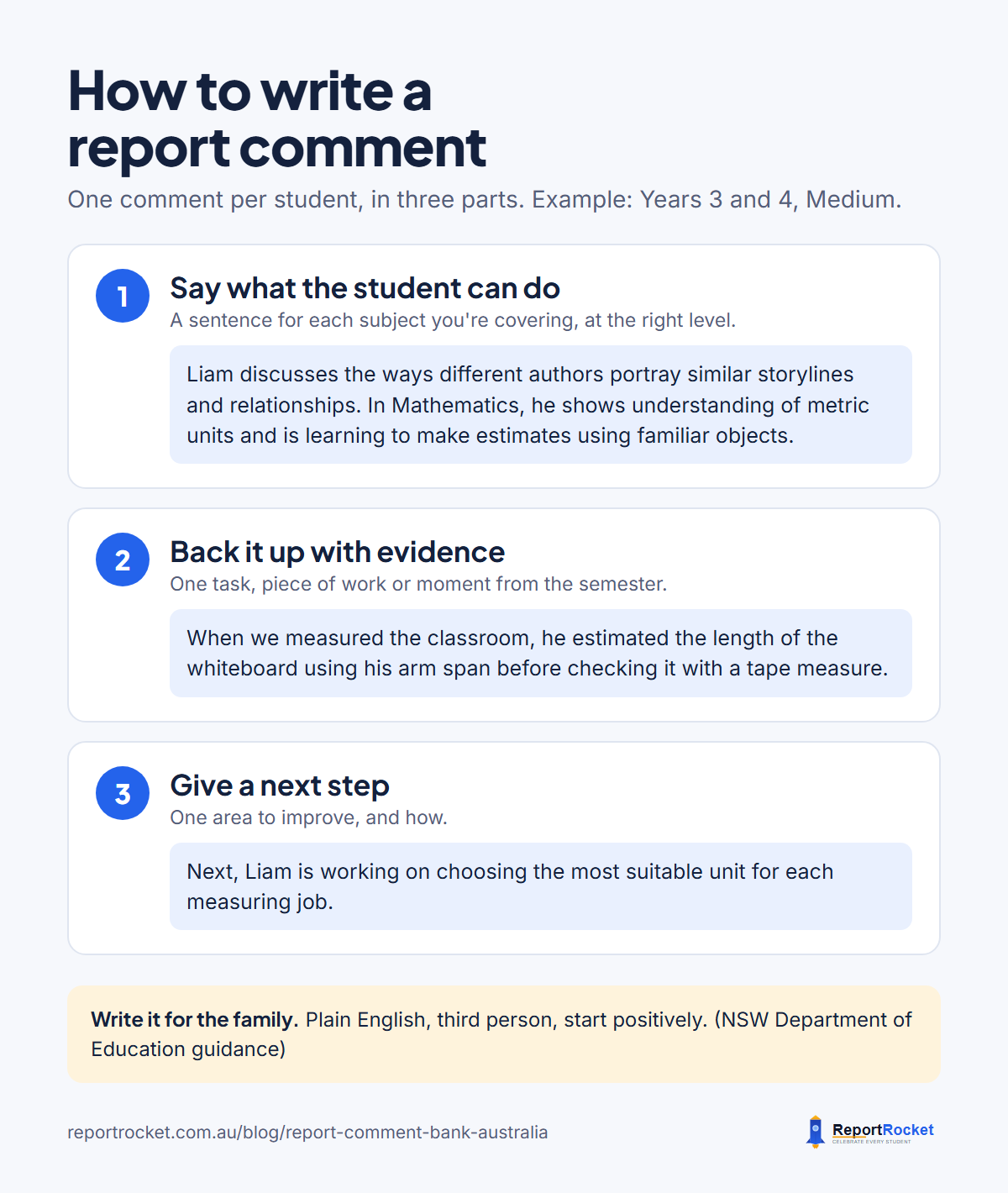
A strong report comment follows the same shape every time:
- Say what the student can do. Pick a sentence from this bank for each subject you're covering, at the right level.
- Back it up with evidence. Add one specific task, piece of work or moment from the semester.
- Give a next step. Finish with one area for improvement and how it can be achieved.
Research backs this shape up. When ACER researchers studied Australian school reports, they found the most useful comments describe what a student can do and name the specific skills the student needs to work on next. General praise was the hardest for families to interpret.
Write it for the family, not the student. The NSW Department of Education's guidance asks for plain English without syllabus jargon, written in the third person and starting positively.
Here is a Years 3 and 4 comment built that way from two Medium sentences in this bank, one from English and one from Mathematics:
"Liam discusses the ways different authors portray similar storylines and relationships. In Mathematics, he shows understanding of metric units and is learning to make estimates using familiar objects. When we measured the classroom, he estimated the length of the whiteboard using his arm span before checking it with a tape measure. Next, Liam is working on choosing the most suitable unit for each measuring job."
Choosing the Level
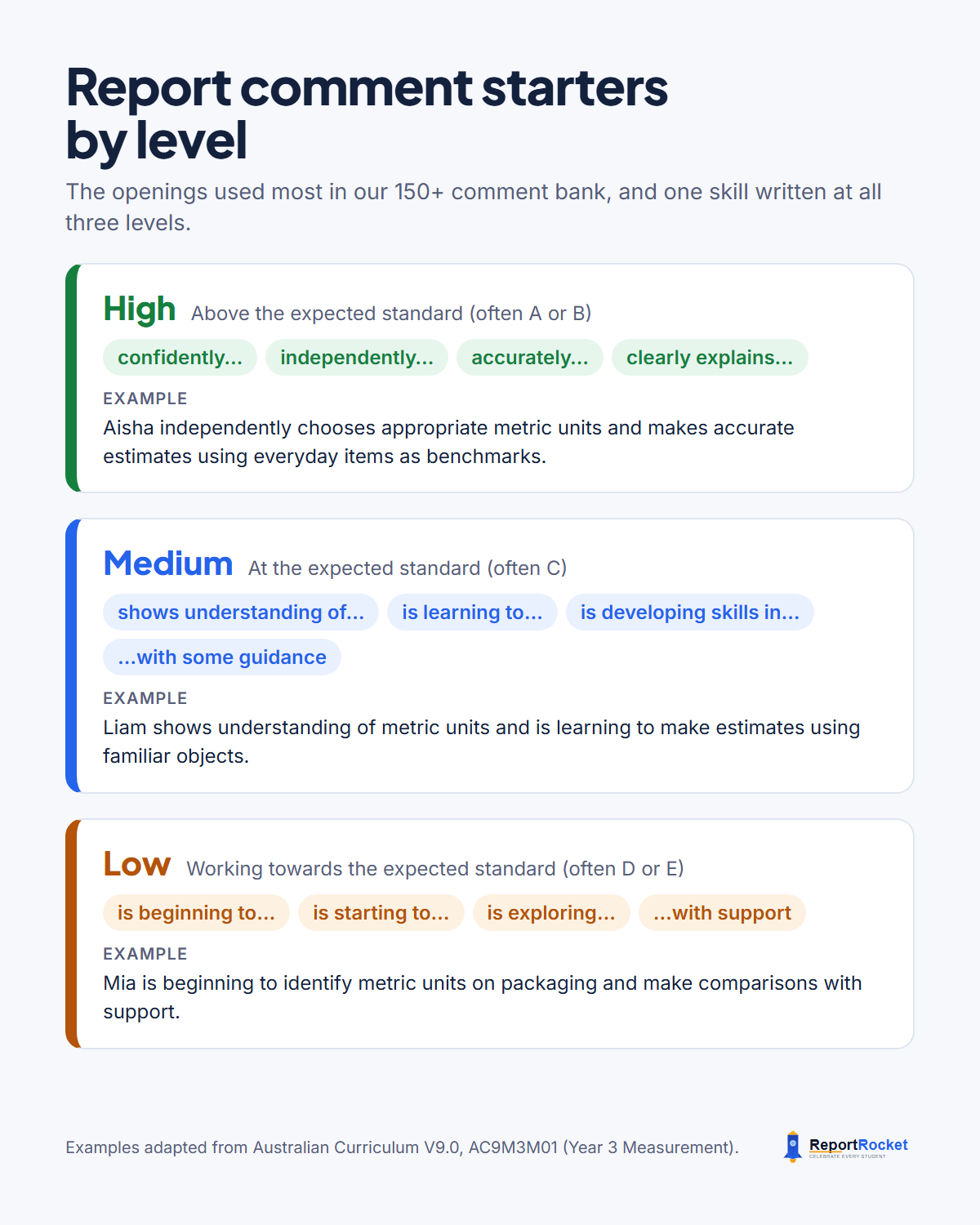
Every subject comment in this bank comes in three versions. Pick the one that matches where the student is:
| Level | Use it when the student is | On an A to E scale, often |
|---|---|---|
| High | Above the expected standard | A or B |
| Medium | At the expected standard | C |
| Low | Working towards the expected standard | D or E |
Australian schools must report each subject on an A to E scale or an equivalent five-point scale (regulation 59 of the Australian Education Regulations 2023). South Australia's parent guide to written reports explains that a C typically means a student is achieving what is expected at their year level. The grade column is a guide only, because your school's scale has the final say.
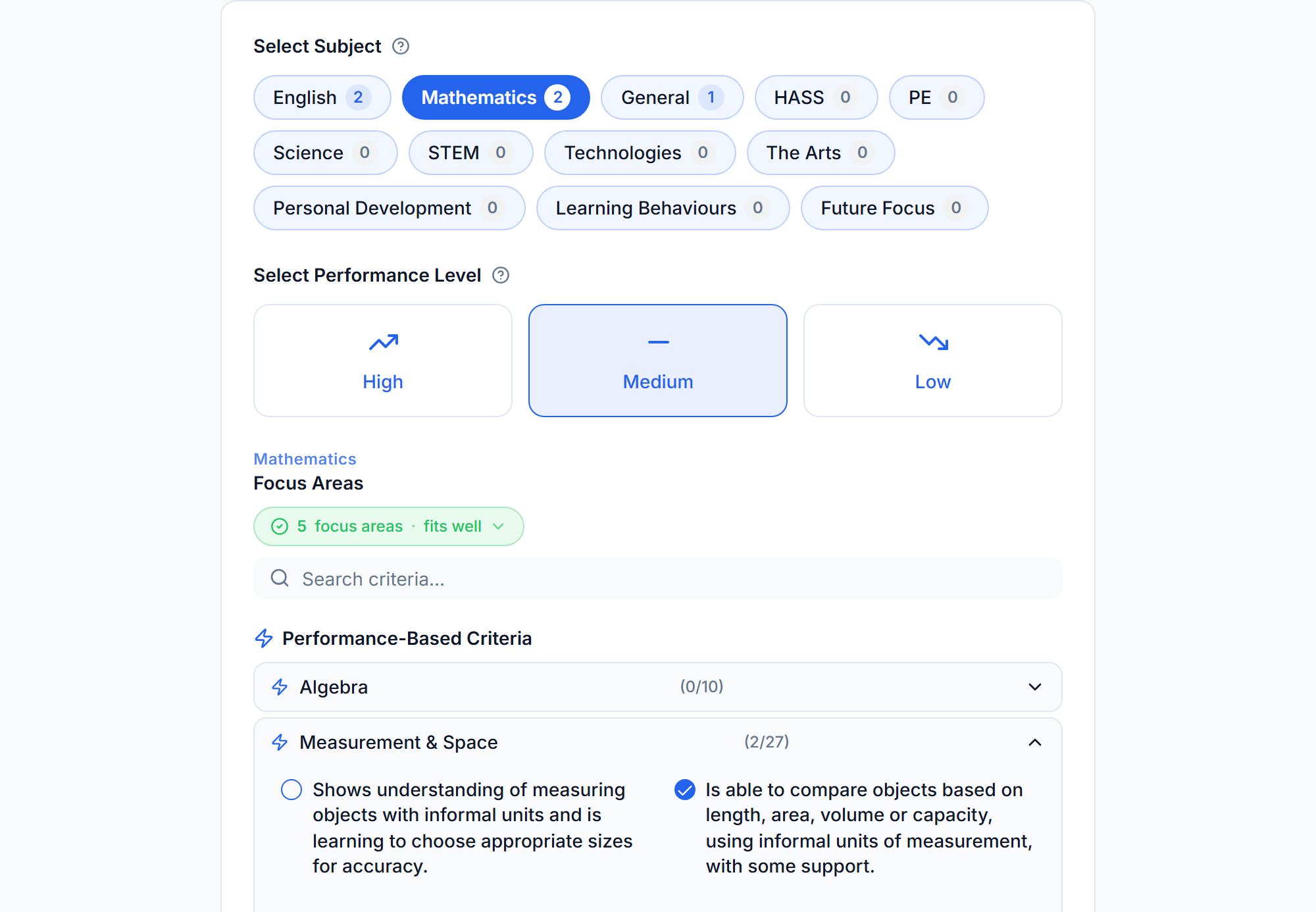
ReportRocket does this for you. You tick the criteria that describe the student, choose High, Medium or Low, and add a line only you would know. ReportRocket writes the comment from those choices in your school's style. Watch it write one.
English Report Comments
Years 1 and 2
Curriculum codes (Australian Curriculum V9.0, in the order of the comments below): AC9E1LA01, AC9E1LE01, AC9E1LY14
High (above the expected standard)
- "[Student] uses words, gestures and facial expressions to communicate clearly with others."
- "[Student] confidently discusses how authors and illustrators use words and pictures to build characters, settings and events."
- "[Student] reads and writes a wide range of high-frequency words with confidence."
Medium (at the expected standard)
- "[Student] is developing an understanding of how body language and tone affect communication."
- "[Student] is learning to identify how writers and illustrators use words and images to create characters and settings."
- "[Student] reads and writes a growing number of high-frequency words."
Low (working towards the expected standard)
- "[Student] is beginning to notice how facial expressions show different feelings."
- "[Student] is beginning to notice how words and pictures help bring a story to life."
- "[Student] is developing the ability to read and write some high-frequency words with support."
Years 3 and 4
Curriculum codes (Australian Curriculum V9.0, in the order of the comments below): AC9E3LA01, AC9E4LE01, AC9E3LY01
High (above the expected standard)
- "[Student] confidently uses turn-taking and discussion skills to work well with others in a group."
- "[Student] offers thoughtful insights into the ways different authors portray similar storylines, ideas and relationships."
- "[Student] clearly explains how writers adapt a text to suit different audiences."
Medium (at the expected standard)
- "[Student] is learning to take turns and use appropriate language when working with others."
- "[Student] discusses the ways different authors portray similar storylines and relationships."
- "[Student] understands that texts with a similar purpose are adapted for different audiences, with some guidance."
Low (working towards the expected standard)
- "[Student] is beginning to understand how to share speaking time during group activities."
- "[Student] is beginning to discuss how different authors tell similar stories."
- "[Student] is starting to explore how texts can be written for different audiences."
Years 5 and 6
Curriculum codes (Australian Curriculum V9.0, in the order of the comments below): AC9E6LA01, AC9E5LY01, AC9E5LE01
High (above the expected standard)
- "[Student] confidently adapts their language to suit the situation, from casual conversations to formal presentations."
- "[Student] confidently explains how texts reflect the time and place in which they were written."
- "[Student] confidently explores how stories reveal important details about different times, places and cultures."
Medium (at the expected standard)
- "[Student] shows understanding of when to use formal language and when casual speech suits the setting."
- "[Student] explains how a text shows the time and place it was written through its language and ideas."
- "[Student] explores how stories reveal details about different times, places and cultures."
Low (working towards the expected standard)
- "[Student] is beginning to notice that we speak differently in formal situations than in everyday conversation."
- "[Student] is beginning to notice, with guidance, how texts show the time and place they were written."
- "[Student] is starting to notice how stories reflect different times and places."
Mathematics Report Comments
Years 1 and 2
Curriculum codes (Australian Curriculum V9.0, in the order of the comments below): AC9M1A01, AC9M2N01, AC9M1M01
High (above the expected standard)
- "[Student] recognises, continues and creates complex patterns formed by skip-counting."
- "[Student] confidently recognises, reads, writes and orders numbers to 1000."
- "[Student] confidently compares and orders objects by length, mass and capacity using different methods."
Medium (at the expected standard)
- "[Student] recognises, continues and creates patterns formed by skip-counting with some support."
- "[Student] shows understanding of the order of numbers to 1000 and can represent numbers with guidance."
- "[Student] compares and orders objects by length, mass and capacity with some support."
Low (working towards the expected standard)
- "[Student] is beginning to recognise and continue skip-counting patterns with support."
- "[Student] is working towards recognising and ordering numbers to 1000 with ongoing support."
- "[Student] is beginning to compare objects by length, mass and how much they hold."
Years 3 and 4
Curriculum codes (Australian Curriculum V9.0, in the order of the comments below): AC9M3N01, AC9M4A01, AC9M3M01
High (above the expected standard)
- "[Student] confidently reads, writes, counts and orders numbers to 10 000 and beyond."
- "[Student] accurately solves missing number problems using number properties and inverse operations."
- "[Student] independently chooses appropriate metric units and makes accurate estimates using everyday items as benchmarks."
Medium (at the expected standard)
- "[Student] reads, writes, counts and orders numbers to 10 000 and beyond."
- "[Student] is developing strategies to find missing numbers in equations."
- "[Student] shows understanding of metric units and is learning to make estimates using familiar objects."
Low (working towards the expected standard)
- "[Student] reads, writes, counts and orders numbers to 10 000 with assistance."
- "[Student] is beginning to find unknown numbers in simple addition and subtraction problems."
- "[Student] is beginning to identify metric units on packaging and make comparisons with support."
Years 5 and 6
Curriculum codes (Australian Curriculum V9.0, in the order of the comments below): AC9M5N01, AC9M5A01, AC9M6M01
High (above the expected standard)
- "[Student] confidently interprets, compares and orders decimals to three decimal places using place value."
- "[Student] confidently explains how multiplication and division work as inverse operations and creates fact families independently."
- "[Student] accurately converts between metric units and chooses appropriate decimal measurements for different situations."
Medium (at the expected standard)
- "[Student] interprets, compares and orders decimals to three decimal places using place value knowledge."
- "[Student] shows understanding of how multiplication and division connect and can create number fact families."
- "[Student] converts between metric units and chooses appropriate decimal measurements."
Low (working towards the expected standard)
- "[Student] is beginning to understand decimals to three places and needs support to compare and order them on a number line."
- "[Student] is beginning to see the connection between multiplication and division as inverse operations."
- "[Student] needs support to convert between metric units and choose appropriate decimal measurements."
Science Report Comments
Years 1 and 2
Curriculum codes (Australian Curriculum V9.0, in the order of the comments below): AC9S1U01, AC9S2I01, AC9S1H01
High (above the expected standard)
- "[Student] identifies what plants and animals need and clearly explains how their habitats provide these."
- "[Student] independently asks thoughtful questions about patterns and makes logical predictions based on observations."
- "[Student] confidently explains many ways science helps people in daily life, such as cooking, gardening and planning for the weather."
Medium (at the expected standard)
- "[Student] is learning to identify what plants and animals need to live and how their environments meet those needs."
- "[Student] shows understanding of simple patterns and is learning to ask questions and make predictions."
- "[Student] shows understanding of how science is used in everyday activities such as cooking and caring for plants."
Low (working towards the expected standard)
- "[Student] is beginning to recognise that animals and plants need things like food and water."
- "[Student] notices patterns and makes simple predictions with encouragement."
- "[Student] is beginning to identify simple examples of science in daily life with teacher support."
Years 3 and 4
Curriculum codes (Australian Curriculum V9.0, in the order of the comments below): AC9S3U01, AC9S4I01, AC9S4H01
High (above the expected standard)
- "[Student] accurately identifies living and non-living things and explains animal and plant life cycles in detail."
- "[Student] independently asks thoughtful questions about patterns and confidently makes predictions from observations."
- "[Student] clearly explains how scientists use data to build their explanations."
Medium (at the expected standard)
- "[Student] shows understanding of the characteristics of living things and can describe the basic stages of a life cycle."
- "[Student] asks questions about patterns and makes predictions from observations."
- "[Student] shows understanding of how scientists gather data to explain their findings."
Low (working towards the expected standard)
- "[Student] can describe a few characteristics of living things, such as growing and moving."
- "[Student] is beginning to notice patterns and ask questions about what they observe."
- "[Student] is beginning to explore how scientists collect information to explain what they discover."
Years 5 and 6
Curriculum codes (Australian Curriculum V9.0, in the order of the comments below): AC9S5U01, AC9S6U04, AC9S6I06
High (above the expected standard)
- "[Student] confidently explains how features such as sharp beaks or plant adaptations help living things survive in different environments."
- "[Student] confidently explains why some changes can be reversed while others create completely new materials."
- "[Student] writes detailed scientific reports, choosing language and digital tools that suit the audience."
Medium (at the expected standard)
- "[Student] shows understanding of how structural features such as camouflage or thick stems help animals and plants survive."
- "[Student] shows understanding of which changes can be reversed and which cannot."
- "[Student] is developing skills in writing scientific reports and choosing suitable language for the purpose."
Low (working towards the expected standard)
- "[Student] is beginning to identify features that help living things survive in their habitats."
- "[Student] is beginning to notice the difference between changes that can and cannot be reversed."
- "[Student] is beginning to write simple scientific texts and explore ways to share their findings."
HASS Report Comments
Years 1 and 2
Curriculum codes (Australian Curriculum V9.0, in the order of the comments below): AC9HS1K02, AC9HS1S01
High (above the expected standard)
- "[Student] confidently identifies what has changed and what has stayed the same between family life today and in their grandparents' time."
- "[Student] asks thoughtful questions about people, places and events from the past and present."
Medium (at the expected standard)
- "[Student] shows understanding of the similarities and differences between family life in the past and present, with some guidance."
- "[Student] shows understanding of how to ask questions about past and present topics."
Low (working towards the expected standard)
- "[Student] is beginning to notice basic differences between their daily life and how families lived long ago."
- "[Student] is beginning to ask simple questions about people and places."
Years 3 and 4
Curriculum codes (Australian Curriculum V9.0, in the order of the comments below): AC9HS3K01, AC9HS4S01
High (above the expected standard)
- "[Student] competently explains how the local community has changed and recognises the contributions of diverse people to those changes."
- "[Student] independently develops thoughtful questions to guide investigations about people, events and places."
Medium (at the expected standard)
- "[Student] is learning to connect changes in the community with the people involved."
- "[Student] develops relevant questions to guide investigations about people, events and places."
Low (working towards the expected standard)
- "[Student] is starting to understand how things in the community have changed and why."
- "[Student] is beginning to form simple questions for investigations, with support."
Years 5 and 6
Curriculum codes (Australian Curriculum V9.0, in the order of the comments below): AC9HS6K06, AC9HS6S05
High (above the expected standard)
- "[Student] accurately explains how Australia's system of government works and confidently compares it with the Westminster system."
- "[Student] independently develops well-supported conclusions by examining reliable sources of evidence."
Medium (at the expected standard)
- "[Student] shows understanding of Australia's system of government and is learning to compare it with the Westminster system."
- "[Student] shows understanding of how to form conclusions using evidence, with some guidance."
Low (working towards the expected standard)
- "[Student] is beginning to explore how Australia's government is organised and its connection to the Westminster system."
- "[Student] is exploring the difference between conclusions based on evidence and personal opinions."
The Arts Report Comments
Years 1 and 2
Curriculum codes (Australian Curriculum V9.0, in the order of the comments below): AC9ADA2E01, AC9ADR2E01
High (above the expected standard)
- "[Student] confidently explains how different dances tell stories and share cultural meanings from a range of communities."
- "[Student] independently explores and discusses how drama connects cultures and communities."
Medium (at the expected standard)
- "[Student] shows understanding of how dance movements and costumes communicate cultural stories and traditions."
- "[Student] shows understanding of how drama expresses feelings and shares important community stories."
Low (working towards the expected standard)
- "[Student] is beginning to notice differences between dances from different cultures and communities."
- "[Student] is beginning to notice drama in everyday life and asks simple questions about it."
Years 3 and 4
Curriculum codes (Australian Curriculum V9.0, in the order of the comments below): AC9ADA4C01, AC9AMA4C01
High (above the expected standard)
- "[Student] confidently creates original dances that express ideas through varied movements and dance elements."
- "[Student] creates engaging media projects that communicate ideas through thoughtful use of images, sound and technology."
Medium (at the expected standard)
- "[Student] is developing skills in combining movements and dance elements to communicate simple ideas."
- "[Student] is developing skills in using cameras, sound and digital tools to create media that shares ideas."
Low (working towards the expected standard)
- "[Student] is beginning to explore how movements can be put together to create short dances."
- "[Student] is beginning to explore how photos, videos and sound can tell stories and share messages."
Years 5 and 6
Curriculum codes (Australian Curriculum V9.0, in the order of the comments below): AC9ADR6C01, AC9AMA6C01
High (above the expected standard)
- "[Student] confidently creates convincing characters and storylines that communicate meaning to an audience."
- "[Student] independently creates engaging media works that use a range of technologies to communicate clear messages to a specific audience."
Medium (at the expected standard)
- "[Student] is developing skills in creating characters and using voice and movement effectively."
- "[Student] is developing skills in using media tools and processes to create works that share ideas with an audience."
Low (working towards the expected standard)
- "[Student] is beginning to explore how to create characters and communicate ideas through drama."
- "[Student] is starting to explore how media tools can be used to express ideas for others."
Health and Physical Education Report Comments
Years 1 and 2
Curriculum codes (Australian Curriculum V9.0, in the order of the comments below): AC9HP2M01, AC9HP2P02
High (above the expected standard)
- "[Student] confidently performs a wide range of movement skills and applies them successfully in games and activities."
- "[Student] confidently identifies and uses skills for building respectful relationships."
Medium (at the expected standard)
- "[Student] is developing fundamental movement skills and shows good understanding when playing different games."
- "[Student] is learning to use skills and strategies that help build respectful relationships."
Low (working towards the expected standard)
- "[Student] is beginning to explore basic movement skills such as running, jumping and catching, with encouragement."
- "[Student] is beginning to explore skills for building respectful relationships."
Years 3 and 4
Curriculum codes (Australian Curriculum V9.0, in the order of the comments below): AC9HP4M01, AC9HP4P01
High (above the expected standard)
- "[Student] independently combines running, jumping and throwing skills to complete challenging movement tasks."
- "[Student] confidently explains how people grow stronger through challenges and setbacks."
Medium (at the expected standard)
- "[Student] is developing the ability to link different movement skills together in simple activities."
- "[Student] identifies how successes, challenges and setbacks can build resilience."
Low (working towards the expected standard)
- "[Student] is exploring how to combine basic movements such as running and jumping, with support."
- "[Student] is beginning to understand how successes and challenges contribute to resilience."
Years 5 and 6
Curriculum codes (Australian Curriculum V9.0, in the order of the comments below): AC9HP6M01, AC9HP6P01
High (above the expected standard)
- "[Student] confidently adapts movement skills such as dodging, balancing and throwing across different sports and activities."
- "[Student] confidently explains how different people and places shape who we are."
Medium (at the expected standard)
- "[Student] shows understanding of how to modify movements when moving between different physical activities."
- "[Student] shows understanding of how role models and cultural connections influence identity."
Low (working towards the expected standard)
- "[Student] is beginning to explore how to adjust simple movements such as running and jumping in different situations."
- "[Student] is beginning to explore how family, friends and community help shape a sense of self."
Next Steps and Closing Sentences
Next Steps
A next step gives the student and their family something to work on. Match it to the level you chose.
For a student above the expected standard
- "Next, [Student] is encouraged to explain their thinking in more detail when sharing ideas."
- "To extend their learning, [Student] could take on more open-ended problems and investigations."
- "A next step for [Student] is to share the strategies that work for them with classmates."
For a student at the expected standard
- "A goal for [Student] is to check their work carefully before handing it in."
- "A goal for [Student] is to share their ideas more often during group discussions."
- "Next, [Student] could work on applying these skills more independently."
For a student working towards the expected standard
- "[Student] may benefit from continued practice with [skill], both at school and at home."
- "With ongoing support, [Student] is building the confidence to attempt new tasks independently."
- "A focus for [Student] is [skill], which we are practising in small groups."
Closing Sentences for Semester 2
- "[Student] has grown in confidence this year and is well prepared for the year ahead."
- "It has been a pleasure having [Student] in our class this year."
- "[Student] has been a kind and thoughtful member of our class this semester."
- "[Student] has shown real determination when work was difficult this semester."
- "[Student] has become more independent this semester and is ready for the challenges of next year."
- "[Student] has made pleasing progress this semester and can be proud of their effort."
- "[Student] has been a steady and reliable presence in our class this year."
- "[Student] has come a long way this semester and finishes the year on a high."
How to Use This Comment Bank
A comment bank is a starting point. These habits turn a bank sentence into a comment that sounds like you:
- Pick the closest match in each subject. For every subject the comment covers, choose the sentence nearest to what the student has been working on, at the right level.
- Swap general wording for specifics. Change "different texts" to "the class novel and our information texts about Australian animals".
- Add something only you would know. A project, a moment of growth or a personal strength.
- Check your school's style guide. Character limits, tone and words your school avoids all matter.
- Read it out loud. If you wouldn't say it at a parent-teacher interview, rewrite it.
Teaching Foundation? The Years 1 and 2 sentences are a good starting point, and ReportRocket includes a full set of Foundation criteria.
Want the whole comment written? In ReportRocket you tick the criteria for each subject, choose the level and add your own note. ReportRocket writes a personalised comment in your school's style, and a colleague can review it before it goes home. Try it yourself, or read about our school report writer.
Frequently Asked Questions
How do I write a report comment for a student who is struggling?
Start with something the student can do, using phrases like "is beginning to" or "with support" rather than "can't" or "doesn't". Then give one area for improvement and how it can be achieved, like the Low comments and next steps in this bank.
How do I stop my report comments sounding the same for every student?
Keep the bank sentence for the skill, then change the evidence: a task, a book or a moment from the semester that only fits that student. Vary the next step too, so two students at the same level don't end up with the same comment. ACER's research on Australian reports found general, interchangeable comments are the hardest for families to make sense of.
Do report comments have to match the grade?
Yes. The NSW Department of Education's guidance says written comments "must be based on evidence collected across the reporting period and support the overall judgement and grade". Other states and sectors set their own rules, so check your school's reporting policy too.
What words should I avoid in report comments?
NSW guidance asks for plain English and a professional, positive tone, so leave out syllabus jargon and labels like "lazy" or "naughty". The same guidance suggests "could" or "may" rather than "should" or "will", to avoid predictions. Your school's style guide may list more words, and ReportRocket checks each comment against it.
Can I reuse a student's Semester 1 comment in Semester 2?
Families may read both reports together, so repeated sentences stand out. Keep what's still true, but update the evidence and set a new next step. In ReportRocket, the Semester 1 comment sits beside the new one and Check comment marks any sentence said twice.
How long should a report comment be?
Follow your school's character limit first. There's no national length, but NSW guidance asks for concise comments, and ACER's research found the most useful ones name a specific next step rather than adding general praise.
Sources
- Australian Curriculum, Assessment and Reporting Authority (ACARA), Australian Curriculum Version 9.0. The codes under each year band are its content descriptions, which the subject comments are adapted from. Licensed under CC BY 4.0.
- NSW Department of Education, Writing report comments.
- Hilary Hollingsworth and Jonathan Heard, Australian Council for Educational Research (ACER), Teacher comments in school reports: What's effective?, Teacher magazine.
- NSW Education Standards Authority, Reporting and using grades, on the A to E requirement in regulation 59 of the Australian Education Regulations 2023.
- Department for Education South Australia, Written reports for primary and secondary students: parent information.
ReportRocket helps Australian primary teachers write personalised, curriculum-aligned report comments. Get started free.
Jandrie Lombard
Founder of ReportRocket. 30 years in IT, now building tools that help Australian primary teachers write better reports in less time. Read more →